
Established in August 2001, the Chesapeake Watershed Cooperative Ecosystem Studies Unit (CW CESU) is a partnership of over 70 research institutions and 12 federal agencies whose members strive to understand and protect the natural, cultural, and social resources of the region. With the Appalachian Laboratory as its lead administrative agency, the CW CESU is one of a national network of 17 such cooperative research units.
Simplifying the Process
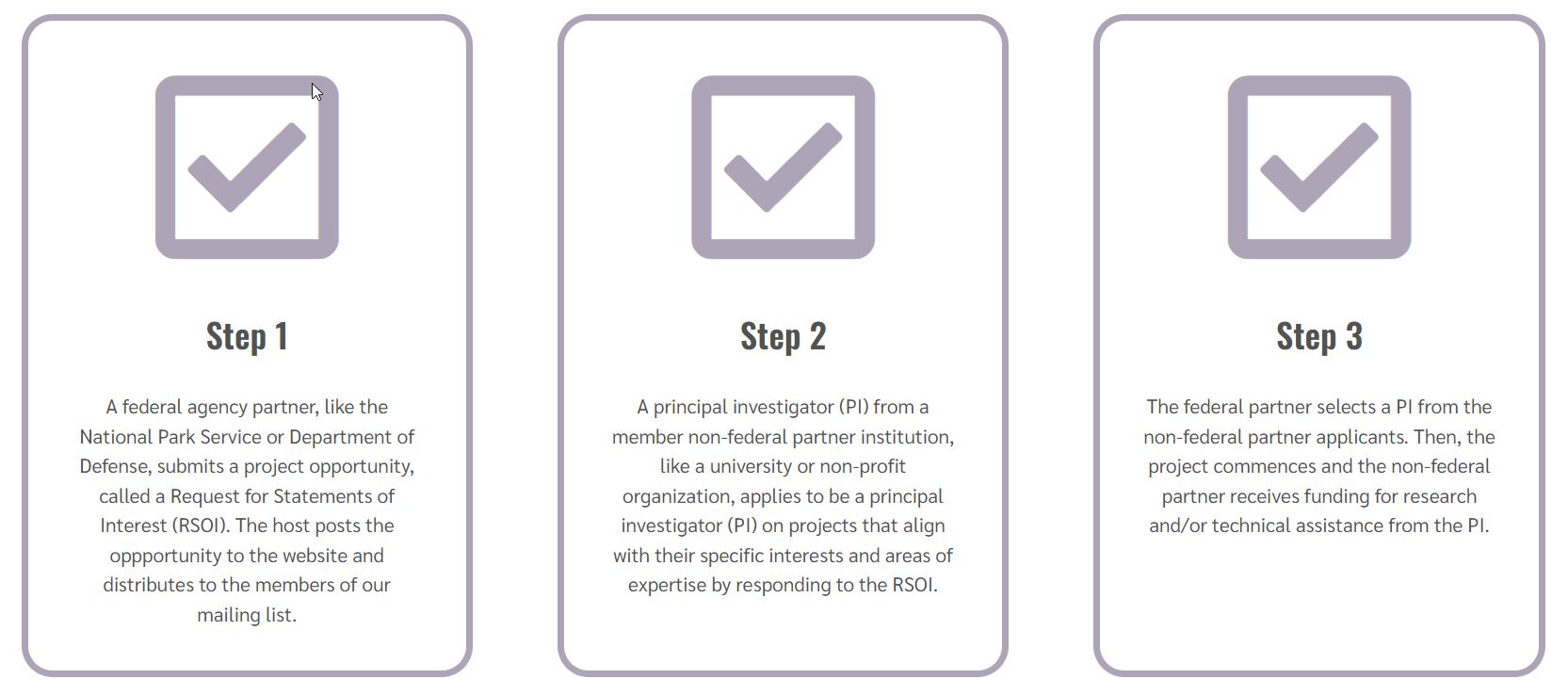
What is a CESU? Nationally, Cooperative Ecosystems Studies Units (CESUs) provide research, technical assistance, and education to federal land management, environment, and research agencies and their partners. By streamlining the funding process, CESUs efficiently facilitate collaboration between partner research institutions and federal agencies on research that informs the agencies’ environmental and cultural management decisions. Research institution partners within the CW CESU provide leadership in watershed science and stewardship with special emphasis on the watershed of the Chesapeake Bay. To learn more about CESUs, visit our CESU National Network page.
To Protect What Matters
The Chesapeake Watershed is home to more than 3,600 species and over 15 million people all competing for resources and space within this 64,000 square mile region. The CW CESU promotes stewardship and integrated ecosystem management of natural and cultural resources within the Chesapeake Watershed through collaborative research, technical assistance, and education.
Our Mission
The CW CESU fosters stewardship of the watershed through collaborative research, technical assistance, and education that support integrated ecosystem management. Emphasizing interdisciplinary and multi-scale approaches, the CW CESU addresses the complex and interrelated biological, physical, cultural, and social resources and issues within this urbanizing landscape. The CW CESU provides national and international leadership in watershed science and stewardship. Our Strategic Planning page provides further information about our current goals and objectives.
Visit our Opportunities page to discover current opportunities or our News page to learn about recent activities associated with the CW CESU.
Our partners are located throughout the Chesapeake Bay watershed and beyond. Use our interactive map below to learn more about our Non-Federal Partners or click in the upper right corner to view the map in a new browser window:
CW CESU Cooperative Agreement
Download CW CESU Agreement for 2026-2031
The 2026-2031 agreement is now fully executed for all signed partners. Any partner who has not yet signed, will remain “inactive” until their signature page has been received (per Article III. A.).
Please contact Dan Filer, danny_filer@nps.gov, or Rhonda Schwinabart, rschwinabart@umces.edu, with any questions regarding your institution’s status.
Past Agreements
Download CW CESU Agreement for 2021-2026
Amendment 1– adding Austin Peay State University, Chesapeake Conservancy, Georgetown University, Immaculata University, Marymount University, the US Naval Academy, and Virginia Department of Wildlife Resources.
Amendment 2– replacing Lock Haven University and Mansfield University with Commonwealth University of Pennsylvania
Amendment 3– adding Monument Lab and Preservation Maryland
Amendment 4– adding Biodiversity Research Institute, Chesapeake Bay Foundation, Harrisburg University of Science and Technology, Leave No Trace, National Council on Public History, and the Native Plant Trust.
Amendment 5– adding the Defense POW/MIA Accounting Agency (DPAA)
Amendment 6– adding the Bureau of Safety and Environmental Enforcement (BSEE)
Amendment 7– adding Henry M. Jackson Foundation for the Advancement of Military Medicine, Inc.
2016
Amendment 1 adding Shepherd University
Amendment 2 adding Virginia Tech
Amendment 3 adding Binghamton University, Bowie State University, Ecological Society of America, Longwood University, Maryland Institute College of Art, Morgan State University, Ohio University, Park Rx America, St. Mary’s College of Maryland, Stroud Water Research Center, University of Maryland Eastern Shore, and University of Pennsylvania
Amendment 4 adding Bureau of Indian Affairs and Bureau of Ocean Energy Management
Amendment 5 adding Association for the Study of African American Life and History, Bryn Mawr College, DC Department of Energy and Environment, Hood College, Lock Haven University, Mansfield University, Old Dominion University, Smithsonian Institution, Towson University, and West Virginia University
Amendment 6 adding National Aeronautics and Space Administration; American Indian Higher Education Consortium; Association of African American Museums; Gallaudet University; Indiana University; Johns Hopkins University; Live It, Learn It; Monmouth University; NatureServe; and Temple University
Amendment 7 adding Conservation Science Global